


 Magyar
 English

Fleet inspection at BKV completed: bus transport is safe and stable
BKV did not find any defects that could endanger the safety of passengers in any way during the extraordinary fleet inspection that the company ordered at the request of the mayor after the fires in August. The inspection determined that the minor defects discovered – oil contamination, fluid leakage, cable wear – can be traced back to the advanced age of the vehicles. These are continuously being repaired, and the company's specialists also performed extraordinary dry ice cleaning, so-called aquatex oil-neutralizing engine compartment cleaning and high-pressure washing in the engine compartments of the buses. The investigation of the specific fires in August is still ongoing with the involvement of external experts.
BKV specialists inspected 855 buses between 14 August and 29 August. The extraordinary inspection was ordered by the company, in accordance with the request of the mayor, after two vehicles caught fire within a short period of time and one had smoke in its engine compartment. None of the passengers were injured. During the extraordinary inspection, the vehicles’ engines, electrical wiring, engine and transmission oil lubrication systems, and the functionality of powder extinguishers and automatic fire extinguishing equipment were examined, among other things. Due to the specific characteristics of the heterogeneous rolling stock consisting of several types of buses and of different ages, the inspection specifically addressed the individual characteristics of the vehicle types. As a priority task, the maintenance workers performed extraordinary dry ice cleaning, aquatex oil-neutralizing engine compartment cleaning, and high-pressure washing in the engine compartments of the buses.
During the inspection, the experts discovered oil contamination, fluid leakage, and wear of electrical wires and cables, typically in some of the buses older than 10 years. Repairs to the defects, which were mostly due to the age of the buses, were started immediately, and some repair phases were almost completely completed. None of the defects were of a nature that would have endangered the safety of passengers. The technical problems that emerged during the inspection are not unknown to BKV specialists, and they have been faced with them regularly in recent decades. Every item of the fleet undergoes a strict daily, weekly, and quarterly inspection, as well as an annual technical inspection. The inspection established that the problems can be largely traced back to the age of the vehicles, and that there is a risk of breakdowns even with the highest level of maintenance. Since passenger safety is first priority for the company, technical inspections have become stricter in parallel with the aging of the fleet.
The professionalism of maintenance is also confirmed by BKV accident statistics. While the company's passengers take buses almost 300 million times a year, over the past six years there have been one or two bus accidents each year with personal injury that can be traced back to a sudden technical failure. While BKV's obvious goal is to prevent all such failures, it is important to note that none of these were fires.
As a result of thorough technical inspections tailored to the age of the fleet, the number of fires related to buses has been showing a decreasing trend for years.
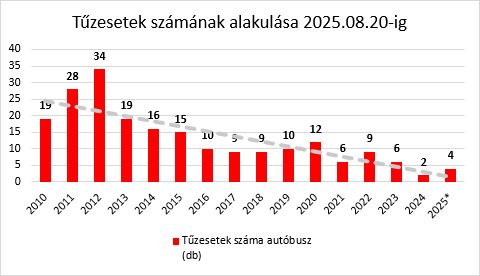
No one has ever been injured in a fire caused by a technical fault on the company's buses. All buses are equipped with automatic fire extinguishing equipment, and the passenger compartment is separated from the engine compartment, so passengers can safely and quickly leave the vehicle in the event of a technical problem. According to our current knowledge, a detailed investigation of the unrelated August fires is still ongoing, and BKV is involving external experts to determine what caused the vehicles to catch fire.
BKV, together with the city administration, believes that the reduction of technical faults and maintenance costs can only be achieved by purchasing new vehicles. Compared to the average age of 14-15 years in previous years, the current average age of the entire fleet is 12.8 years, while the optimal maximum lifespan for buses is 8-10 years. More than 200 buses are older than 20 years. Currently, half of BKV's bus fleet, 420 vehicles, are due for replacement. The replacement of buses has begun in recent years, and the previous high-floor vehicles have been replaced. Rejuvenating the bus fleet is a key goal of BKV. The company has prepared the necessary purchases, and hundreds of new buses may arrive in Budapest's public transport in the coming years. Until the necessary funds are created, BKV has signed a contract to rent 65 new buses as an additional solution. The brand-new vehicles will be in service from the end of the year. Until the new vehicles are put into service, we will further develop the protocols for forced over-operation – with the involvement of universities. This is an existing system already used by BKV, which we have now extended to buses. Its essence is that in the case of assets (vehicles, infrastructure elements) that are operated beyond their planned lifespan out of necessity, the special tests and inspection methods that should be applied in the interests of safe operation should be determined with scientific support. Another inspection by the Government Office of Budapest Capital City is currently underway at BKV. During the inspections in recent days, the authority has required that additional buses undergo technical inspections. It should be noted, however, that the condition of the vehicles – whether they are passenger cars or buses – may change between two technical inspections, but the vehicle can be used safely until the minor defect is corrected. At BKV, this is guaranteed by regular inspections.
Bkv Zrt.